Day 15 of Becoming an AI Developer: What Is Agentic AI? Explained for Beginners
From chatbots that answer questions to AI systems that take actions — here’s what Agentic AI actually means for developers.
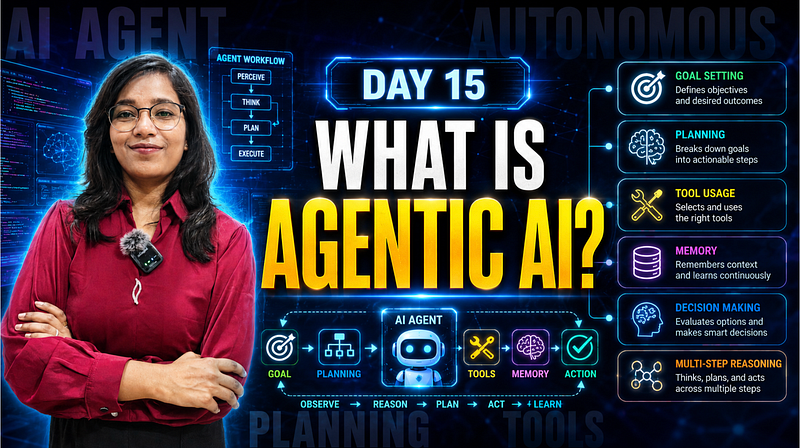
A few years ago, asking AI to book a meeting, search the web, analyse documents, and send a report would have sounded impossible.
Today, AI can do exactly that.
Not because models suddenly became smarter.
But because developers stopped treating AI as a chatbot and started treating it as an agent.
And that shift is creating one of the biggest changes in software development right now.
If you’ve already learned about LLMs, RAG, embeddings, vector databases, and context windows in this series, Agentic AI is the next logical step.
It combines all those concepts into systems that can reason, plan, use tools, and complete tasks independetly.
If you would like to learn AI with us, make sure to save this series. It’s free and available to everyone on Medium
Zero to AI Expert in 30 Days
The Problem With Traditional LLM Applications
Most AI applications work like this:
- User asks a question
- LLM generates a response
- Done
Example:
const response = await openai.chat.completions.create({
 model: "gpt-4o",
 messages: [
 {
 role: "user",
 content: "Explain React hooks"
 }
 ]
});
The model answers.
But it cannot:
- Search the internet
- Access databases
- Use APIs
- Perform actions
- Verify information
It only generates text.
This is where Agentic AI comes in.
What Is Agentic AI?
Agentic AI refers to AI systems that can:
- Understand a goal
- Break it into steps
- Use tools when needed
- Make decisions
- Execute actions
- Evaluate results
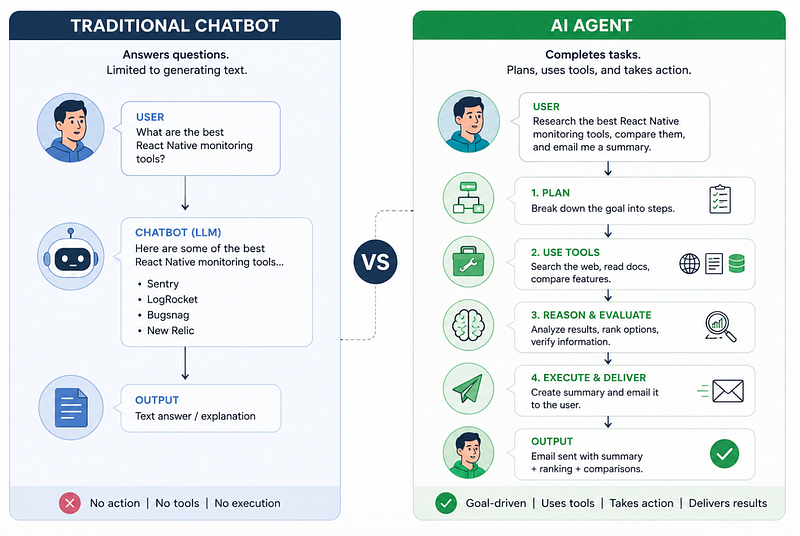
Instead of simply answering questions, the AI acts like a digital worker.
Think about this prompt:
“Research the top AI startups, create a summary, and email it to me.”
A normal chatbot might describe how to do it.
An AI agent can actually perform the workflow.
Difference Btw Tradition Chatbot and AI Agent
How Agentic AI Works
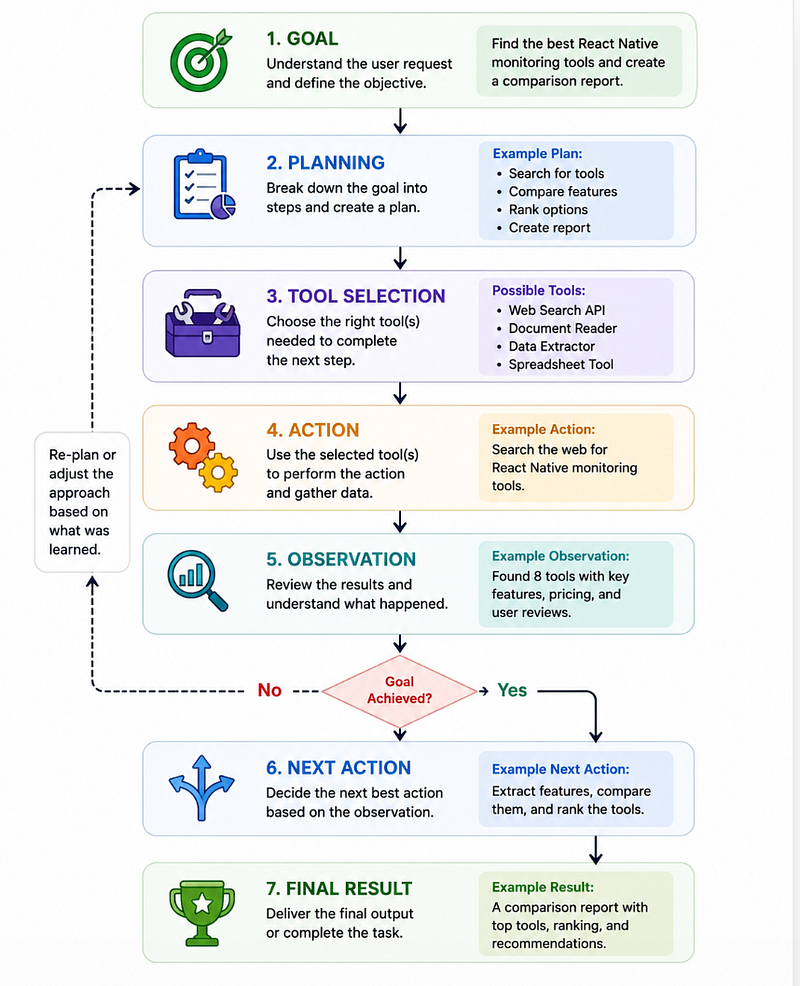
Most agents follow a loop:
Step 1: Understand the Goal
User:
Find the best React Native monitoring tools.
The AI first identifies the objective.
Step 2: Create a Plan
The agent might generate:
1. Search for monitoring tools
2. Compare features
3. Rank options
4. Generate report
This planning step is critical.
Step 3: Use Tools
Agents don’t rely only on their training data.
They can call:
- APIs
- Search engines
- Databases
- Vector stores
- Internal tools
Example:
const searchResults = await searchTool(
 "best React Native monitoring tools"
);
Step 4: Evaluate Results
The agent checks:
if (results.length < 5) {
 searchAgain();
}
Instead of stopping after one attempt, it can refine its approach.
Step 5: Produce Final Output
Finally-
return finalReport;The user receives a completed task rather than just information.
The Core Components of an AI Agent
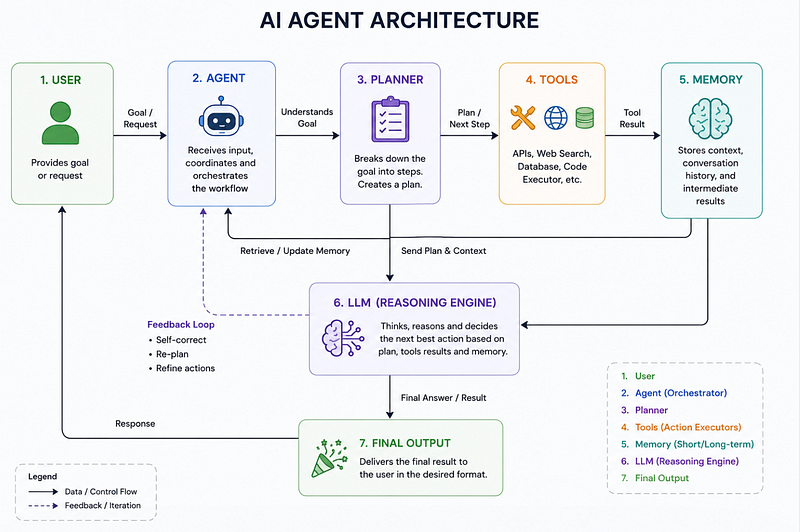
Most modern agents contain these building blocks:
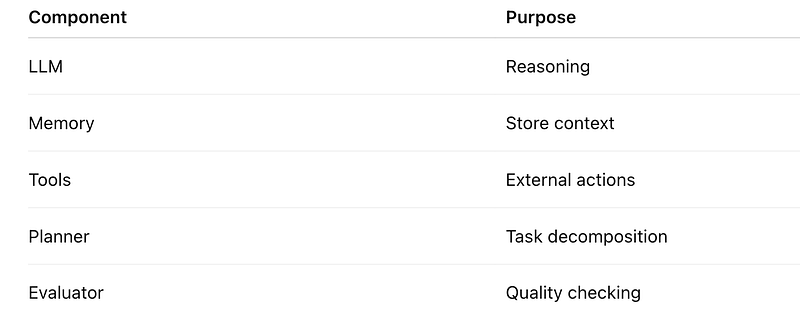
Together, they create autonomos behaviour.
Real-World Agent Example
Imagine a Job Application Agent.
User:
Find remote React jobs and create a spreadsheet.
The workflow could look like:
1. Search LinkedIn
2. Search company careers pages
3. Filter remote roles
4. Extract job details
5. Create spreadsheet
6. Send summary
Notice something interesting.
The user never specifies the individual steps.
Only the goal.
The agent figures out the rest.
AI Agent Architecture
Simple Agent Example in JavaScript
A very simplified version:
async function agent(goal) {
 const plan = await createPlan(goal);
 for (const step of plan) {
 await executeStep(step);
 }
 return "Task completed";
}
Real-world frameworks add:
- Tool calling
- Memory
- Error recovery
- Multi-step reasoning
But the core idea remains the same.
Popular Agent Frameworks
Developers commonly use:
LangGraph
Best for:
- Production workflows
- Stateful agents
- Complex decision trees
CrewAI
Best for:
- Multi-agent systems
- Team-like workflows
Example:
Research Agent
 ↓
Analysis Agent
 ↓
Writing Agent
OpenAI Agents
Best for:
- Tool calling
- Simpler implementations
- Fast development
Common Mistakes Developers Make
Mistake 1: Giving Too Much Freedom
Bad:
Do everything for me.Good:
Research AI startups in India
and create a summary report.
Clear goals produce better results.
Mistake 2: No Tool Restrictions
Agents should only access necessary tools.
Too many tools increase confusion.
Mistake 3: No Validation Layer
Never assume the agent is always correct.
Add verification:
if (!report.hasSources) {
 regenerateReport();
}
Trust, but verify.
The Surprising Insight About Agentic AI
Most people think Agentic AI is about smarter models.
It isn’t.
The biggest improvement comes from better workflows, not bigger LLMs.
A well-designed agent using a smaller model often outperforms a powerful model with no planning, memory, or tool usage.
That’s why companies are investing heavily in agent architectures rather than only chasing larger models.
The future may not belong to a single super-intelligent AI.
It may belong to networks of specialised agents working together.
Key Takeaways
- Traditional LLMs generate responses.
- Agentic AI systems execute tasks.
- Agents can plan, reason, use tools, and evaluate outcomes.
- Memory, planning, and tool calling are the foundation of modern agents.
- Frameworks like LangGraph, CrewAI, and OpenAI Agents make implementation easier.
- The real power comes from workflow design, not just model size.
If LLMs were the brains of modern AI systems, agents are the employees that actually get work done.
And as developers, learning how to build them may become one of the most valuable AI skills of the next few years.
Missed the previous articles?
Read here: Build a Resume Analyser Using AI
Read here: Vector Databases Explained
🚀 Transitioning into AI as a developer?
I’m building a practical 30-day roadmap to help developers move into AI — step by step, without random tutorials or confusion.
👉 Follow this series so you don’t miss the next day.
👉 Bookmark this article — you’ll want to revisit it.
👉 What’s the biggest thing confusing you about AI right now? Drop it in the comments — I may cover it next.