What Is Artificial Intelligence? A Beginner-Friendly Guide to How Machines Think and Learn
Discover how AI works, where it’s used, and what makes it powerful — along with its limitations and ethical challenges.
Introduction
Artificial Intelligence (AI) is no longer just a futuristic idea — it’s already part of our daily lives. From voice assistants to recommendation systems, AI is quietly working behind the scenes to make technology smarter and more useful.
But what exactly is AI? How does it work? And what makes it different from human intelligence?
In this article, we’ll break down AI in a simple, beginner-friendly way — covering its core concepts, real-world applications, and the challenges that come with it.
What Is Artificial Intelligence?
Artificial Intelligence refers to machines or computer systems designed to mimic human intelligence. These systems can perform tasks that usually require human thinking, such as:
- Learning from data
- Solving problems
- Making decisions
- Understanding language
- Recognizing images
Instead of being explicitly programmed for every step, AI systems learn patterns from large amounts of data and improve over time.
How Does AI Work?
At its core, AI works by processing data and identifying patterns. The more data it analyzes, the better it becomes at making predictions or decisions.
Key Technologies Behind AI
Let’s look at the main building blocks:
1. Machine Learning (ML)
Machine Learning allows systems to learn from data without being explicitly programmed.
Example:
Email spam filters learn which emails are unwanted by analyzing past data.
2. Deep Learning (DL)
A more advanced form of machine learning that uses layered models to process complex data.
Example:
Voice assistants that understand speech and respond accurately.
3. Neural Networks
These are systems inspired by the human brain, made up of interconnected nodes that process information in layers.
Example:
Image recognition systems that can identify faces or objects.
4. Natural Language Processing (NLP)
This enables machines to understand and respond to human language.
Example:
Chatbots and translation tools.
5. Computer Vision
Allows machines to interpret visual data like images and videos.
Example:
Facial recognition or medical image analysis.
Core Capabilities of AI
Modern AI systems can do much more than simple automation. Some of their key capabilities include:
- Understanding language: Chatbots and virtual assistants
- Pattern recognition: Detecting trends or anomalies in data
- Prediction: Forecasting outcomes like sales or risks
- Personalisation: Recommending products or content
- Goal-based actions: Completing tasks based on defined objectives
Real-World Applications of AI
AI is transforming industries across the board. Here are some practical examples:
1. Healthcare
AI helps analyse medical images, detect diseases, and even assist in drug discovery.
2. E-commerce
Platforms recommend products based on your browsing and purchase history.
3. Customer Support
Chatbots handle common queries, reducing response time and improving efficiency.
4. Transportation
Self-driving technologies and route optimisation systems rely heavily on AI.
5. Smart Devices
Voice assistants and smart home devices use AI to automate everyday tasks.
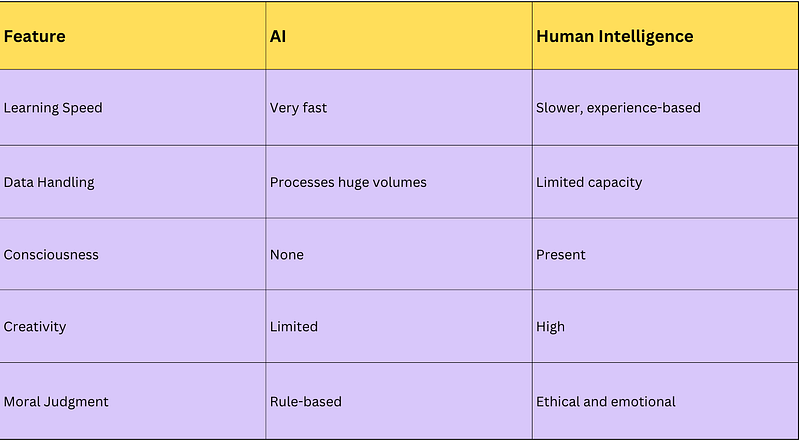
AI vs Human Intelligence
AI and human intelligence may seem similar, but they are fundamentally different.
Key Insight
AI excels at speed, accuracy, and repetitive tasks, but it lacks consciousness, emotions, and moral reasoning.
Ethical Challenges in AI
As AI becomes more powerful, it raises important ethical questions.
1. Bias
AI systems can reflect biases present in training data, leading to unfair outcomes.
2. Transparency
Many AI systems operate as “black boxes,” making it hard to understand how decisions are made.
3. Accountability
Who is responsible when an AI system makes a mistake?
4. Privacy and Safety
AI systems often rely on large amounts of personal data, raising concerns about misuse.
To address these issues, frameworks focus on:
- Fairness
- Transparency
- Accountability
- User safety
A Brief History of AI
AI has evolved over decades through key milestones:
- 1950: Concept of machine intelligence introduced
- 1956: AI becomes a formal field of study
- 1997: AI defeats a world chess champion
- 2011: AI demonstrates advanced language understanding
- 2012: Breakthrough in image recognition
- 2020s: Rise of generative AI systems
Today, AI is moving toward more advanced capabilities, but true human-level intelligence (AGI) is still theoretical.
Limitations and Unknowns
Despite rapid progress, AI still has several limitations:
- No universal definition covering all aspects of AI
- Lack of transparency in decision-making (“black box” problem)
- Dependence on high-quality data
- Limited adaptability beyond specific tasks
- Uncertainty about future developments like AGI
These challenges highlight the need for continued research and responsible development.
Conclusion
Artificial Intelligence is a powerful technology that is reshaping how we live and work. It enables machines to learn, adapt, and make decisions with impressive speed and accuracy.
However, it is not a replacement for human intelligence. Instead, it is a tool — one that works best when combined with human judgment, creativity, and ethics.
As AI continues to evolve, understanding its strengths and limitations becomes more important than ever.
Key Takeaways
- AI simulates human intelligence using data and algorithms
- Core technologies include machine learning, deep learning, and neural networks
- AI is widely used in healthcare, business, transportation, and daily tech
- It excels in speed and accuracy but lacks consciousness and moral reasoning
- Ethical concerns like bias and transparency are critical
- AI is powerful but still evolving, with many unknowns ahead