Want to Get Into AI in 2026? Start Here (Without Feeling Overwhelmed)
A realistic roadmap for software developers who want to move into AI without drowning in hype, math anxiety, or tutorial overload.
A strange thing is happening in tech right now.
Developers are spending more time watching AI content than actually building with AI.
One day it’s “Learn Machine Learning!”
The next day, it’s “AI Agents are replacing apps!”
Then someone says, “You must master Linear Algebra before touching AI.”
And suddenly, full-stack developers feel stuck.
Where do you even start in 2026?
Here’s the good news:
You do not need to become an ML researcher to build a strong AI career.
In fact, most developers entering AI in 2026 will likely become AI Engineers, not research scientists.
And that changes everything.
First: Stop Trying to Learn “All of AI”
This is the biggest mistake developers make.
They try learning:
- Machine Learning
- Deep Learning
- Neural Networks
- Reinforcement Learning
- Generative AI
- RAG
- Fine-tuning
- AI Agents
- MLOps
…all at once.
Result?
Tutorial paralysis.
The AI field is now too large to learn everything first.
Instead, think like a developer:
Learn only what helps you build useful products.
For most software engineers, the fastest entry point is:
AI Engineering → LLM Apps → Agentic Systems → Advanced AI
The AI Learning Pyramid For Developers
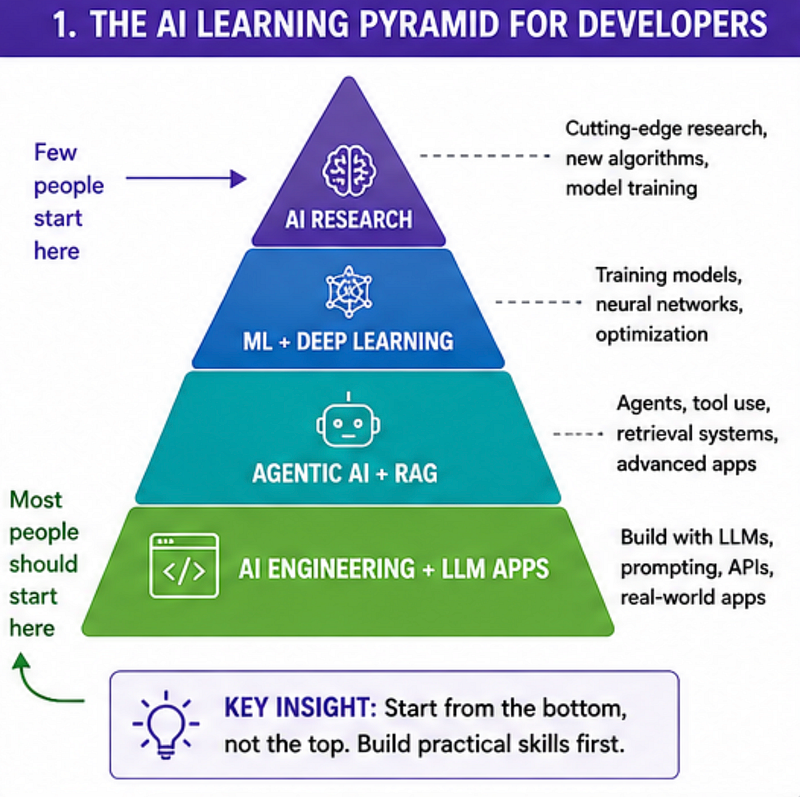
Key Insight: Start from the bottom, not the top.
What AI Actually Looks Like in 2026
Many developers imagine AI work means training giant models.
Reality?
Most companies are doing things like:
- Building AI chat features
- Creating internal copilots
- Automating workflows
- Extracting information from documents
- Building AI agents
- Adding search using RAG
You’re usually using models, not creating them.
Think of it like cloud engineering.
Most developers use AWS.
Very few build AWS.
Same thing with AI.
A Practical AI Roadmap for Full-Stack Developers
Let’s simplify the roadmap.
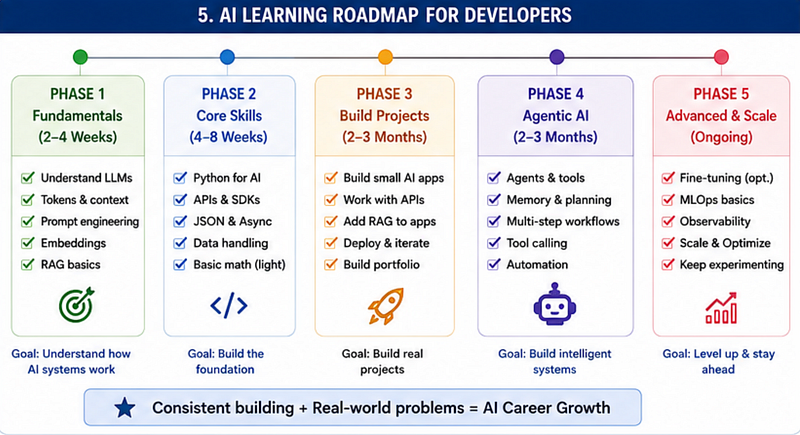
Phase 1: Learn AI Fundamentals (2–4 Weeks)
Don’t start with math-heavy ML.
Start with understanding:
- What is an LLM?
- Tokens
- Prompt engineering
- Context windows
- Embeddings
- Vector databases
- Hallucinations
- RAG basics
Goal:
Understand how AI systems behave.
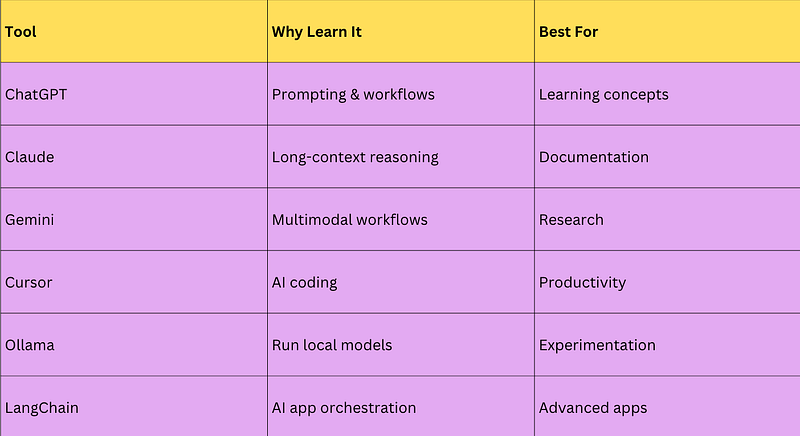
Tools to Explore
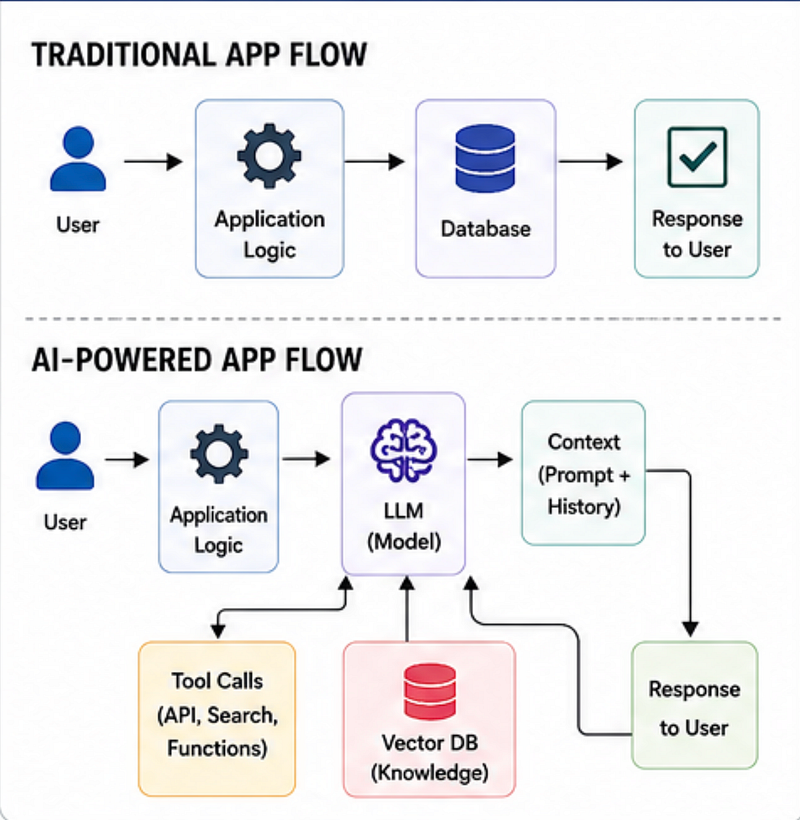
Traditional App Flow vs AI-Powered App Flow
Phase 2: Learn Python (If You’re a JavaScript Developer)
Yes, JavaScript developers can work in AI.
But Python still dominates the ecosystem.
You don’t need expert-level Python.
Focus on:
- Functions
- APIs
- JSON handling
- Async basics
- File processing
You’ll mostly use Python to glue systems together.
Example: Your First AI API Call
from openai import OpenAI
client = OpenAI()
response = client.chat.completions.create(
 model="gpt-4.1-mini",
 messages=[
 {
 "role": "user",
 "content": "Explain RAG simply"
 }
 ]
)
print(response.choices[0].message.content)
Why This Matters
This teaches:
- API communication
- Model interaction
- Prompt behavior
- AI debugging
Common mistake:
Developers spend months studying theory before building anything.
Instead:
Build first. Learn theory while building.
Phase 3: Build Small AI Projects
This is where most learning happens.
Don’t build “The Next ChatGPT.”
Build boring but useful things.
Start with:
Beginner Projects
- Resume feedback tool
- AI code reviewer
- PDF summarizer
- Meeting notes generator
- Customer support chatbot
Intermediate Projects
- RAG document assistant
- Multi-agent workflow system
- AI automation dashboard
- Internal company copilot
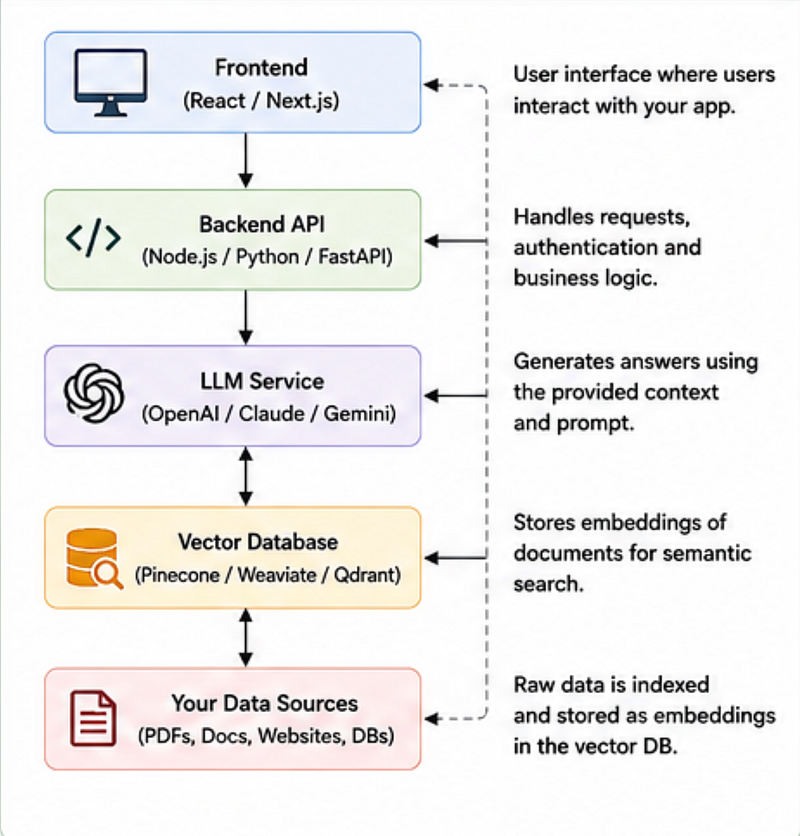
AI Application Architecture
Phase 4: Learn Agentic AI
This is where AI is heading in 2026.
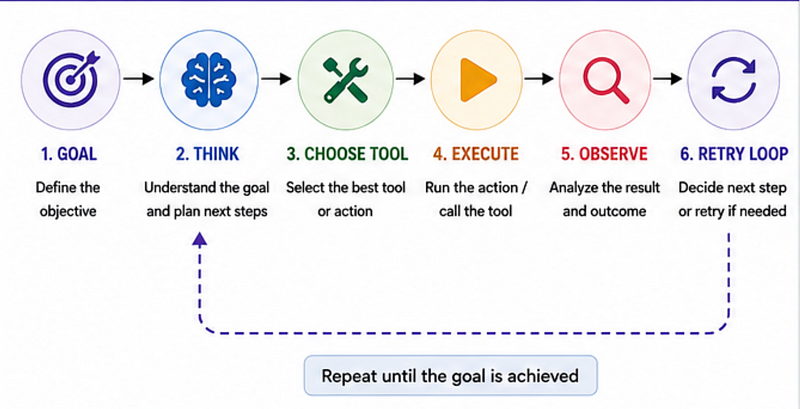
Agentic systems don’t just answer questions.
They:
- Think
- Choose tools
- Execute tasks
- Observe results
- Retry if needed
Example:
Instead of asking:
“What are today’s top AI jobs?”
An AI agent could:
- Search job boards
- Filter by skills
- Compare salaries
- Summarize trends
- Recommend learning paths
Agentic AI workflow Loop
Realistic Expectations (The Part Nobody Talks About)
Let’s remove the hype.
Expectation #1: You won’t become an AI expert in 30 days
A realistic timeline:
- 1 month: Understand fundamentals
- 3 months: Build AI side projects
- 6 months: Become job-ready for AI engineering roles
- 12+ months: Strong practical confidence
Expectation #2: AI jobs still need software engineering
Companies are not hiring “prompt engineers” everywhere.
They want developers who understand:
- APIs
- Architecture
- Backend systems
- Scaling
- Databases
- Product thinking
Your full-stack background is already valuable.
Expectation #3: You do NOT need advanced math immediately
This surprises many developers.
If your goal is:
Building AI products → math can come later.
If your goal is:
Research scientist → math becomes critical.
That distinction saves months of confusion.
The Surprising Truth About Breaking Into AI
The fastest developers entering AI are often not the ones learning the most.
They’re the ones building consistently.
A developer who builds:
- 5 AI projects
- 1 portfolio case study
- 1 production AI feature
…often beats someone who finished 20 theoretical AI courses.
Because employers care about:
“Can you build useful AI systems?
Not:
“Did you memorize transformer architecture?”
Final Thoughts
If you want to get into AI in 2026:
Don’t try to learn everything.
Start small.
Learn the foundations.
Build practical projects.
Understand LLMs.
Experiment with agents.
And most importantly:
Treat AI like software engineering — not magic.