Stack Overflow Becoming Dead Silently: What It Means for Developers Today
LLMs making Stack Overflow Irrelevant?
Let’s be honest: When was the last time you opened Stack Overflow?
Not by accident. Not through a random Google result. But intentionally — to ask, answer, or even just browse?
For most devs I know, the answer is: “Months ago.”
And that’s wild.
Because just a few years ago, Stack Overflow was the place for every error, every syntax doubt, every weird bug at 2 AM. It was more than a Q&A site — it was a collective brain of modern programming.
As a dev, I have visited Stack Overflow in 2020–2022, 10 times a day to debug what’s actually gone wrong in my app.
So what happened? And more importantly… what happens now?
The Traffic Is Down. Way Down.
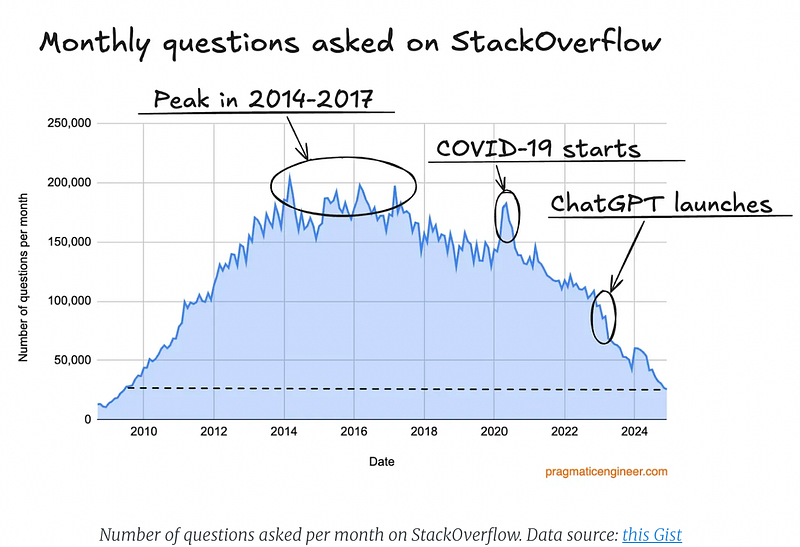
According to multiple public tools and reports (like this analysis by Gergely Orosz), Stack Overflow’s traffic has dropped by 50 %+ since 2022.
The culprit?
You already know: AI. ChatGPT. Claude. Copilot. Gemini. DeepSeek.
When devs can type natural language prompts and get usable code back instantly, why spend 10 minutes reading outdated threads with 12 “it depends” answers?
Now with AI(Copilot, Claude) in IDE, I rarely go to ChatGPT or any other AI to search for answers or code.

But This Isn’t Just About Stack Overflow
It’s a shift in how developers learn, debug, and build and it comes with both massive upsides and hidden dangers.
Let’s break it down:
Why Developers Are Abandoning Stack Overflow
- Faster answers from ChatGPT or Copilot (even for niche questions)
- Even no need to solve the bugs, It is solved by AI by writing a simple prompt.
- No judgment or fear of downvotes
- Less noise, more focused responses
- Easier to integrate AI directly into IDEs (like Copilot, Cursor, or Cody)
- Faster, Less use of the brain, which is preferred by humans, COMFORT
But here’s the twist…
What We’re Losing Along the Way
Remember when answering on Stack Overflow taught you how to explain code clearly?
Or when reading answers, exposed you to multiple approaches to the same problem?
Or when top contributors posted deep dives that felt like mini blog posts?
That depth, community, and credibility?
It’s hard to replicate with an LLM.
Right now, AI gives useful answers.
But it’s Stack Overflow that gave trustworthy ones — backed by reputation, discussion, and peer review.
More in this, we’re losing the learning process, we are running towards easier and quicker solutions instead of understanding the actual problem.
What You Should Do as a Developer in This Transition
Stack Overflow might be dying. But your growth doesn’t have to.
Here’s how to adapt:
1. Use AI, But Validate It
Don’t blindly copy-paste from ChatGPT. Run, test, and understand what it outputs.
2. Give Back to the Community
Write a blog post. Answer a question on Reddit. Help a junior dev in DMs.
The open knowledge culture still matters.
3. Build a Second Brain
Save useful prompts, debug snippets, and edge cases in Notion, Obsidian, or a personal wiki.
Because when Stack Overflow fades, you’ll need your own reference library.
4. Support Modern Communities
Stack Overflow may be struggling, but others are rising: Discords, GitHub Discussions, Twitter dev circles, and niche Slack groups.
Final Thought
Stack Overflow isn’t dying because it failed. It’s fading because we changed.
The way we code, learn, and solve problems has evolved. But that doesn’t mean we stop asking questions — or helping each other find better answers.
Your Turn
How often do you still use Stack Overflow? Has AI changed the way you learn to code?
Share your thoughts in the comments 👇
At Dev Simplified, We Value Your Feedback 📊
👉 Follow us to not miss any updates.
👉 Have any suggestions? Let us know in the comments!