If AI Is Replacing Engineers, Why Are Companies Still Paying $570K for Them?
AI may be transforming software development, but the market signals show that skilled engineers — especially problem solvers — are more valuable than ever.
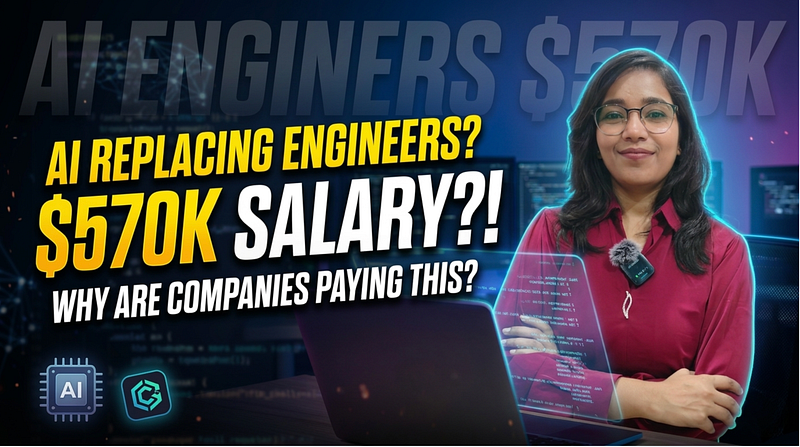
Artificial intelligence is rapidly changing how software is built. Many headlines suggest that AI could soon replace software engineers. Some technology leaders have even predicted that coding jobs might disappear within a year.
Yet, an interesting contradiction recently appeared in the hiring market.
One AI company publicly discussing the possibility of automated coding agents posted a software engineering job offering up to $570,000 in total compensation. Even more surprising, the job listing included a note saying the role might not exist in a year.
At first glance, this sounds contradictory. Why would a company predicting automation still pay such high salaries for engineers today?
The answer reveals something important about the real state of the tech industry.
The Gap Between AI Predictions and Hiring Reality
Public discussions about AI often focus on how quickly technology could automate programming tasks. However, when we look at how companies actually invest their money, a different picture appears.
Many organisations building advanced AI systems are also aggressively hiring experienced engineers. Infrastructure teams are expanding, and competition for senior technical talent remains strong.
This creates a clear contrast:
Public narrative:
- AI will automate coding
- Autonomous development tools are coming
- Engineering roles may shrink
Actual hiring behavior:
- Companies offering very high compensation
- Growing engineering teams
- Strong demand for experienced developers
This difference does not necessarily mean predictions are wrong. Instead, it suggests that the transformation of engineering work is more nuanced than simple replacement.
The Real Shift Happening in Engineering Jobs
AI is changing software development, but not all engineering roles are affected equally.
If we look at the range of responsibilities engineers perform, we can roughly place them on a spectrum.
Task-Focused Roles
These roles often involve repetitive or predictable work, such as:
- Writing routine boilerplate code
- Performing manual testing procedures
- Generating standard reports from structured data
- Implementing clearly defined specifications
Because these tasks follow established patterns, they are easier for AI tools to automate or assist with.
As a result, entry-level positions focused primarily on execution may become less common over time.
Problem-Solving Roles
On the other end of the spectrum are engineers who focus on higher-level decision-making, such as:
- Designing system architecture
- Making trade-off decisions between different technologies
- Diagnosing complex production issues
- Determining what features should be built and why
These responsibilities require judgment, experience, and contextual understanding.
For now, those capabilities remain difficult for AI systems to replicate.
That is why companies still compete intensely to hire engineers who can think strategically and solve complex problems.
How AI Is Actually Used in Software Development
Instead of replacing engineers entirely, AI tools are currently being integrated into development workflows.
A typical AI-assisted development process might look like this:
- Engineer defines requirements
The developer identifies what needs to be built and why. - AI generates initial code structure
Tools can quickly produce boilerplate or repetitive code patterns. - Engineer reviews and improves the code
Developers refine the output, improve readability, and correct issues. - AI helps with testing and edge cases
AI tools may suggest tests or identify potential errors. - Engineer makes architectural decisions
Humans decide how systems should be structured and deployed. - Product is released
In this workflow, AI handles parts of the execution, but human engineers still guide the overall direction.
Why Context and Judgment Still Matter
One of the biggest limitations of AI systems today is the lack of context.
For example, consider a common architectural decision:
Should a company:
- Build a microservice architecture that scales well but adds complexity?
- Extend an existing monolithic application for faster development?
- Use a managed cloud service that simplifies operations but introduces vendor dependency?
The right choice depends on many factors, including:
- Team size
- Budget constraints
- Product growth expectations
- Existing infrastructure
- Organizational priorities
AI systems do not fully understand these business and organizational considerations. Human engineers must evaluate these trade-offs.
This kind of judgment is where much of the value in engineering work now lies.
The Changing Distribution of Engineering Value
In recent years, the balance between execution and decision-making has shifted.
A simplified view might look like this:
A few years ago:
- Judgment and decision-making: 40%
- Execution and coding tasks: 60%
Today:
- Judgment and decision-making: 70%
- Execution tasks: 30%
As AI tools automate routine work, the value of higher-level thinking increases. This shift helps explain why senior engineers remain highly compensated.
What the Market Signals Are Telling Us
Instead of focusing only on predictions about the future, it can be useful to observe how companies behave when real money is involved.
Many organizations developing advanced AI systems are still:
- Hiring experienced engineers
- Offering high compensation packages
- Competing strongly for senior talent
This suggests that the industry still depends heavily on skilled developers who can design systems and solve complex problems.
What This Means for Aspiring Engineers
For people entering the tech industry, the key takeaway is not that engineering jobs are disappearing.
Instead, the expectations are evolving.
Developers who focus only on writing routine code may find increasing competition from automation tools. However, engineers who build deeper skills — such as system design, architecture, and problem-solving — are likely to remain valuable.
In other words, the bar for engineering roles is rising, but the door is not necessarily closing.
The future of engineering will likely involve humans working alongside AI tools, with developers focusing more on strategic thinking and system-level decisions.
For engineers willing to adapt and build deeper technical judgment, the opportunities in this evolving landscape may remain significant.