Day 5 of 60 Days of DSA — Flipping Bits & Merging Intervals
Two powerful interval-based problems that test your ability to reason about subarrays and ranges — both of which are frequent in interviews.

Welcome back to Day 5 of 60 Days of DSA 🚀
By the end of this article, you’ll be confident about:
- Finding the best subarray to maximize 1s in a binary string using a modified Kadane’s algorithm
- Efficiently inserting and merging intervals while maintaining order
- Handling overlapping range logic — a concept used in many advanced DSA and system design problems
Let’s dive right in 👇
Problem 1: Flip — Maximize Number of 1s
Problem Description
You are given a binary string A(i.e., with characters 0 and 1) consisting of characters A1, A2, …, AN. In a single operation, you can choose two indices, L and R, such that 1 ≤ L ≤ R ≤ N and flip the characters AL, AL+1, …, AR. By flipping, we mean changing character 0 to 1 and vice-versa.
Your aim is to perform ATMOST one operation such that in the final string number of 1s is maximized.
If you don’t want to perform the operation, return an empty array. Else, return an array consisting of two elements denoting L and R. If there are multiple solutions, return the lexicographically smallest pair of L and R.
NOTE: Pair (a, b) is lexicographically smaller than pair (c, d) if a < c or, if a == c and b < d.
Problem Constraints
1 <= size of string <= 100000
Input Format
First and only argument is a string A.
Output Format
Return an array of integers denoting the answer.
Example Input
Input 1:
A = "010"Input 2:
A = "111"Example Output
Output 1:
[1, 1]Output 2:
[]Example Explanation
Explanation 1:
A = "010"Pair of [L, R] | Final string
_______________|_____________
[1 1] | "110"
[1 2] | "100"
[1 3] | "101"
[2 2] | "000"
[2 3] | "001"
We see that two pairs [1, 1] and [1, 3] give same number of 1s in final string. So, we return [1, 1].
Explanation 2:
No operation can give us more than three 1s in final string. So, we return empty array [].Solution Approach
When you flip bits:
- Each 0 → 1 increases total 1s by +1
- Each 1 → 0 decreases total 1s by -1
So the task is equivalent to finding a subarray where
👉 (Number of 0s − Number of 1s) is maximum.
In other words, it’s like finding the maximum subarray sum,
If we treat 0 as +1 and 1 as −1.
This is a direct application of Kadane’s Algorithm! ⚡
Solution Code
Solution 1:
Normally, solving it by finding out the difference
function flip(A){
// to convert A to Array from string
 A = Array.from(A).map(el => Number(el));
 let left = 0;
 let finalOp = new Array(2);
 let maxZeros = 0;
 let zeroes = 0, ones = 0;
 for(let i=0 ; i< A.length; i++){
 A[i] == 1? ones++: zeroes++;
 let diff = zeroes-ones;
 if(diff < 0){
 ones = 0;
 zeroes = 0;
 left = i+1;
 }
 if(maxZeros < diff){
 maxZeros = diff;
 finalOp[0] = left+1;
 finalOp[1] = i+1;
 }
 }
 return finalOp[0] ? finalOp: [];
}
Solution 2:
By Kadane’s Algorithm 0->1 and 1->-1
function flip(A){
 // Using kadane's algorithm 0->1 amd 1-> -1
 // problem becomes equal to maximum subarray sum
 A = Array.from(A).map(el => Number(el));
 for(let i=0; i< A.length ; i++){
 if(A[i] == 1){
 A[i] = -1;
 }else{
 A[i] = 1
 }
 }
 let max = 0;
 let left = 0;
 let sum =0;
 let op = new Array(2);
 for(let i=0;i <A.length; i++)
 {
 sum += A[i];
 if(sum > max){
 max = sum;
 op[0] = left+1;
 op[1] = i+1;
 }
 if(sum < 0){
 sum = 0;
 left = i+1;
 }

 }
 return max ==0? []: op;
}
Complexity
- Time: O(N)
- Space: O(1)
Key Takeaways
✅ Convert logical problems into mathematical differences
✅ Kadane’s algorithm is one of the most powerful subarray tools
✅ Always consider lexicographical order in tie-breaking
Problem 2: Insert Interval
Problem Description
You have a set of non-overlapping intervals. You are given a new interval [start, end]. Insert this new interval into the set of intervals (merge if necessary).
You may assume that the intervals were initially sorted according to their start times.
Problem Constraints
0 <= |intervals| <= 105
Input Format
First argument is the vector of intervals
second argument is the new interval to be merged
Output Format
Return the vector of intervals after merging
Example Input
Input 1:
Given intervals [1, 3], [6, 9] insert and merge [2, 5] .Input 2:
Given intervals [1, 3], [6, 9] insert and merge [2, 6] .Example Output
Output 1:
[ [1, 5], [6, 9] ]Output 2:
[ [1, 9] ]Example Explanation
Explanation 1:
(2,5) does not completely merge the given intervalsExplanation 2:
(2,6) completely merges the given intervalsSolution Approach
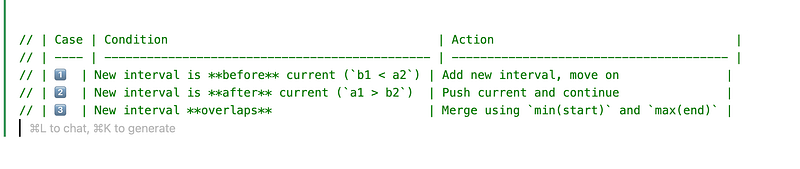
There are three possible cases when comparing intervals:
let’s suppose [a1, b1], [a2,b2] are the two intervals
Solution
function mergeIntervals(A, B){
 let sortedList = []
 let a1 = B[0];
 let b1 = B[1];

 for(let i=0; i<A.length; i++){
 let a2 = A[i][0];
 let b2 = A[i][1];
 if(b1 >= a2){
 if(a1 > b2){
 sortedList.push([a2, b2]);
 }else{
 a1 = a1 > a2 ? a2: a1;
 b1 = b1 > b2 ? b1: b2;
 }
 }else{
 sortedList.push([a1,b1]);
 a1 = a2;
 b1 = b2;
 }
 }
 sortedList.push([a1, b1]);
 return sortedList;
}
⏱️ Complexity
- Time: O(N)
- Space: O(N) (in worst case)
🧭 Key Takeaways
✅ Carefully handle overlapping logic using min/max
✅ Maintaining order is crucial for merging
✅ Visualising intervals on a number line helps build intuition
Quick Quiz
1️⃣ In the Flip problem, if the string is "111", what should be returned?
a) [1,3]
b) [1,1]
c) []
2️⃣ For the Insert Interval problem, if you insert [2,6] into [[1,3],[6,9]], what’s the result?
a) [[1,6],[9,9]]
b) [[1,9]]
c) [[1,3],[2,6],[6,9]]
That’s it for Day 5🎯
You just mastered Kadane’s variation and Interval merging, both extremely common in interviews like Amazon, Google, and Adobe.
Tomorrow, we’ll move to another pattern: Prefix Sum meets Intervals.
Stay consistent — see you in Day 6! 💪
Do you want to solve more with us?
Then follow this series and share your progress in the comments.
At Dev Simplified, We Value Your Feedback 📊
👉 Follow us to not miss any updates.
👉 Have any suggestions? Let us know in the comments!