Day 14 of 60 Days of DSA — Recursion II
Fast Power & Finding All Indices in an Array
Recursion often feels comfortable when problems are small.
But the real test of understanding begins when recursion is used to optimise performance or systematically explore data.
On Day 13, we learned how recursion works through foundational problems.
Today, on Day 14, we take the next step — using recursion to reduce time complexity and replace iterative scans with clean, structured logic.
We’ll solve two classic problems:
- Fast Power (Exponentiation by Recursion)
- Finding All Indices of a Target Element in an Array
Both are frequently used to evaluate how well you understand recursive thinking beyond basics.
Problem 1: Fast Power
Problem Description
Given two positive integers A and B. Implement Fast Power function to compute AB
Problem Constraints
AB would fit in 64-bit type integer.
Example Input
Input 1 :
A = 2 , B = 10
Input 2 :
A = 1 , B = 100000000
Example Output
Output 1 :
1024
Output 2 :
1
Example Explanation
For Input 1 :
210 = 25 * 25
25 = 32, so 32 * 32 = 1024
For Input 2 :
1 raised to power anything is 1
Why Not Use a Loop?
A simple loop multiplies A exactly B times:
- Time Complexity: O(B)
- This becomes inefficient when
Bis large
Fast Power reduces this dramatically by observing a key mathematical insight.
Recursive Intuition (Step-by-Step)
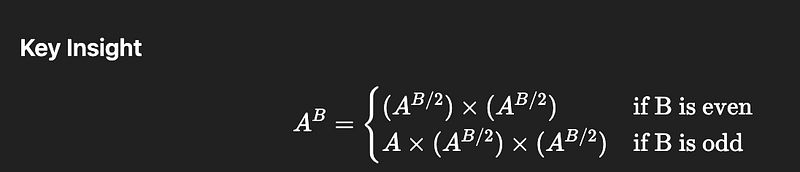
Let’s say:
A = 2, B = 10- Compute
power(2, 5) - Compute
power(2, 2) - Compute
power(2, 1)→ base case - Build the result back while returning
Each recursive call halves B.
Base Cases
- If
B == 0→ return1 - If
B == 1→ returnA
These stop unnecessary recursion.
Code (JavaScript)
function power(A, B){
 A = BigInt(A);
 B = BigInt(B);

 if(B == BigInt(1)) return A;
 if(B == BigInt(0)) return BigInt(1);

 let half = power(A, B/BigInt(2));
 if(B%BigInt(2) == BigInt(0)){
 return half* half;
 }else{
 return A * half* half;
 }
}
Time & Space Complexity
- Time Complexity:
O(log B) - Space Complexity:
O(log B)(recursion stack)
Problem 2: All Indices Of Array
Problem Description
Given an array of integers A with N elements and a target integer B, the task is to find all the indices at which B occurs in the array.
Note: The problem encourages recursive logic for learning purposes. Although the online judge doesn’t enforce recursion, it’s recommended to use recursive solutions to align with the question’s spirit.
Example Input
Input 1:
A = [1, 2, 3, 4, 5]
B = 1
Input 2:
A = [8, 9, 5, 6, 5, 5]
B = 5
Example Output
Output 1:
[0]
Output 2:
[2, 4, 5]
Example Explanation
Explanation 1:
The Target, 1 occurs on Index = 0. So returning [0]
Explanation 2:
Here, the target 5 occurs at indexes [2, 4, 5].
Recursive Strategy
We traverse the array one index at a time:
- If index exceeds array length → stop recursion
- If current element matches target → store index
- Recur for the next index
Code (JavaScript)
function main(A, B){
 let arr = [];
 function findB(A,i,B){
 if(i >= A.length) return;
 if(A[i] == B){
 arr.push(i);
 }
 findB(A, i+1, B);
 }
 findB(A, 0, B);
 return arr;
}
Time & Space Complexity
- Time Complexity:
O(N) - Space Complexity:
O(N)(recursion stack + result array)
Final Thoughts
Today’s problems show two important uses of recursion:
- Optimization (Fast Power)
- Systematic traversal (All Indices)
If you truly understand these patterns, recursion stops feeling magical and starts feeling logical.
In the next days, recursion will become even more powerful when combined with:
- Backtracking
- Divide & Conquer
Until then, keep practicing and tracing recursive calls on paper — it’s the fastest way to master them.
Do you want to solve more with us?
Then follow this series and share your progress in the comments.
If the topics are difficlt for you to understand, then you can refer to the notes on my GitHub.
Here’s the Code link
At Dev Simplified, We Value Your Feedback 📊
👉 Let us know how you’re finding this series so far. It motivates us to write and provide valuable content for you.
👉 Follow us to not miss any updates.