Vite vs Webpack vs Parcel in 2026: Which Bundler Should You Learn First?
A practical, beginner-friendly guide to choosing the right JavaScript bundler for speed, scalability, and career growth
If you’re stepping into modern frontend development or trying to stay relevant in 2026, one question naturally comes up: which bundler should you learn?
With tools evolving rapidly, choosing the right one can directly impact your productivity, learning curve, and even job opportunities. Let’s break it down in a simple, practical way — based strictly on current data and real-world usage.
Why Bundlers Still Matter
Before comparing tools, it’s important to understand their role.
A bundler takes your code (JavaScript, CSS, assets) and prepares it for the browser — optimising, splitting, and packaging everything efficiently. Even though modern browsers support ES modules, bundlers are still essential for performance, scalability, and production readiness.
Vite: The Fastest Way to Build Modern Apps
Vite has quickly become the go-to bundler for modern development, and the reason is simple: speed.
What makes Vite stand out?
- Lightning-fast dev server: Starts in around 280ms
- Instant updates: Hot Module Replacement (HMR) in ~50ms
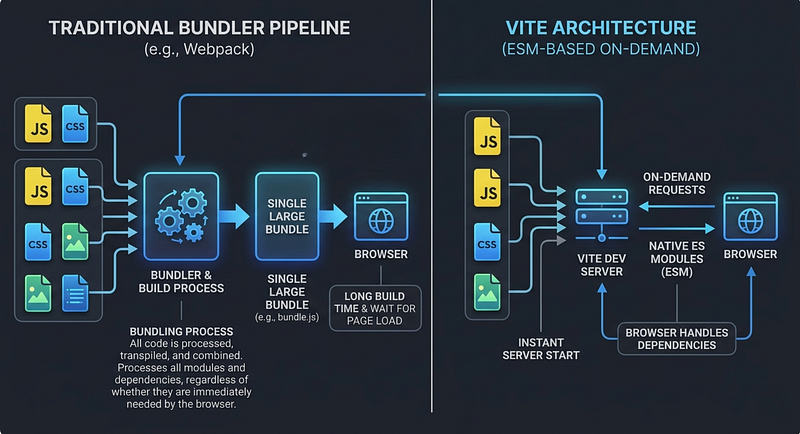
- No full bundling during development: Uses native ES modules
- Minimal setup: Works out of the box for most projects
Instead of bundling everything up front like traditional tools, Vite serves files on demand. This results in near-instant feedback while coding.
Real-world example
Imagine you’re building a React dashboard. With Vite:
- You start the server almost instantly
- Changes are reflected immediately in the browser
- You spend more time building, less time waiting
Ecosystem growth
- ~53 million weekly downloads (2026)
- 97% user satisfaction
- Upcoming Rolldown integration (Rust-based bundler) promises even faster production builds (10–30x improvements)
Best for: Beginners, modern frontend projects, fast iteration
Webpack: Powerful but Complex
Webpack has been around for years and still powers a large portion of production applications.
Why is Webpack still relevant?
- 57% market share (especially in enterprise)
- Highly customizable
- Mature plugin ecosystem
- Proven support for complex architectures
The trade-off
- Slower performance (dev server can take 18–25 seconds)
- Heavy configuration (often 200+ lines)
- Requires loaders and plugins for basic features
Where Webpack shines
Webpack is widely used in large-scale enterprise apps, especially those using:
- Legacy systems
- Highly customised build pipelines
- Micro-frontend architectures
Module Federation advantage
Webpack introduced Module Federation, enabling multiple applications to share code dynamically. This is especially useful in large organisations building independent frontend modules.
Even in 2026, this remains a key reason why Webpack is deeply embedded in enterprise systems.
Best for: Enterprise developers, legacy systems, advanced customisation
Rspack: The Emerging Performance Upgrade
Rspack is a newer tool designed to solve Webpack’s biggest problem: speed.
Key highlights
- Built in Rust
- 5–10x faster builds
- ~5x faster HMR
- Compatible with Webpack configurations
Real-world impact
In large React projects:
- Build time reduced from 185 seconds → 18 seconds
Rspack also integrates SWC, removing the need for tools like Babel or ts-loader.
Best for: Teams using Webpack who want performance improvements without rewriting everything
Parcel: Simple but Limited
Parcel focuses on one thing: zero configuration.
What it does well
- No setup required
- Built-in support for:
- HMR
- Code splitting
- Asset handling
Where it falls short
- Limited ecosystem
- No strong enterprise adoption
- Lacks performance benchmarks compared to others
- Minimal presence in large-scale or TypeScript-heavy apps
When should you use Parcel?
- Quick prototypes
- Learning environments
- Small static websites
Best for: Beginners experimenting or building small projects quickly
Developer Experience: What Feels Better to Use?
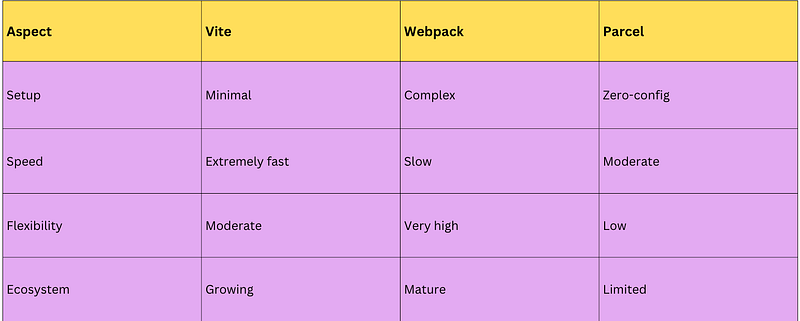
Reality check
- Vite is loved for its simplicity and speed
- Webpack is respected for its power and reliability
- Parcel is appreciated for its ease, but not widely adopted
Enterprise & Micro-Frontend Trends
Webpack still dominates enterprise environments, largely due to its long-standing support for micro-frontends through Module Federation.
However, things are evolving.
Module Federation 2.0 (2026 update)
Now supports multiple bundlers:
- Vite
- Rspack
- Rollup
- Webpack
This means:
- You’re no longer locked into Webpack
- Faster tools like Vite can now be used in enterprise setups
- Cross-bundler compatibility is becoming the norm
What Should You Learn in 2026?
Here’s a practical roadmap:
1. Start with Vite
- Best learning experience
- Matches modern development trends
- High demand and growing adoption
2. Learn Webpack next
- Important for enterprise roles
- Helps you understand deeper build concepts
- Required for legacy systems
3. Explore Rspack (optional but valuable)
- Ideal for working in performance-critical environments
- Smooth transition from Webpack
4. Use Parcel only when needed
- Good for quick experiments
- Not essential for career growth
Limitations to Keep in Mind
- Rspack adoption is still growing; long-term data is limited
- Rolldown (used by Vite) is new — its impact is promising but evolving
- Parcel lacks clear adoption metrics in 2026