Cloud Computing Service Models
We often come across cloud computing models like IaaS, PaaS, and SaaS, but we may not fully understand what they mean or how they work. Let’s take a moment to understand these concepts and explore how they function.
Imagine you want to make your website builder business accessible to people all over the world through a website. What would be the steps to achieve this? You’d need infrastructure, and you could either use existing services or opt for a fully functional application. Cloud computing provides three key service models to achieve this:
- Infrastructure as a Service (IaaS)
- Platform as a Service (PaaS)
- Software as a Service (SaaS)
Let’s go through each model using the example of a website builder business.
1. Infrastructure as a Service (IaaS)
You’ve developed a website builder and want to make it accessible globally. Now, how do you go about that?
Let’s assume your website is ready to be deployed. To serve it to users around the clock, you’ll need to host it on a machine (a server). Traditionally, you’d need to set up a data center, buy servers, and ensure your website is online 24/7. However, this requires a lot of effort, and as your user base grows, you’ll need to scale up with more machines, increasing complexity.
What if someone offered to handle this for you? That’s where IaaS comes in. Cloud providers such as AWS EC2, Azure Virtual Machine, and Azure Kubernetes Services (AKS) offer pre-configured infrastructure. You rent virtual machines or computing power on-demand, without needing to own or maintain physical servers.
2. Platform as a Service (PaaS)
When building your website builder, you’ll likely need a database. You could install a database on your server and host it yourself, but this introduces additional responsibilities — managing security, CPU usage, memory, and scaling. We need a platform to use it directly without having other complexities and we can just focus on development.
With PaaS, these concerns are handled for you. Services like Amazon RDS (Relational Database Service), DynamoDB, and Azure’s cloud services allow you to directly integrate a database into your application without worrying about managing anything else. These platforms offer databases, file storage, queues, and other critical services, making development and deployment smoother.
3. Software as a Service (SaaS)
Now that your website builder is online and people are using it to create their own websites and sell products, what do you think this represents?
Congratulations! You’ve just created a SaaS product. In this model, users interact with fully developed software hosted on the cloud. They don’t need to install or manage anything — your website builder is the software service they use to build their websites. SaaS allows users to access and benefit from a complete, ready-to-use software solution via the internet. Cool, right? 😎
In conclusion, cloud computing models — IaaS, PaaS, and SaaS — provide different levels of service, from infrastructure to platforms and fully functional software, offering flexibility and scalability to businesses of all sizes.
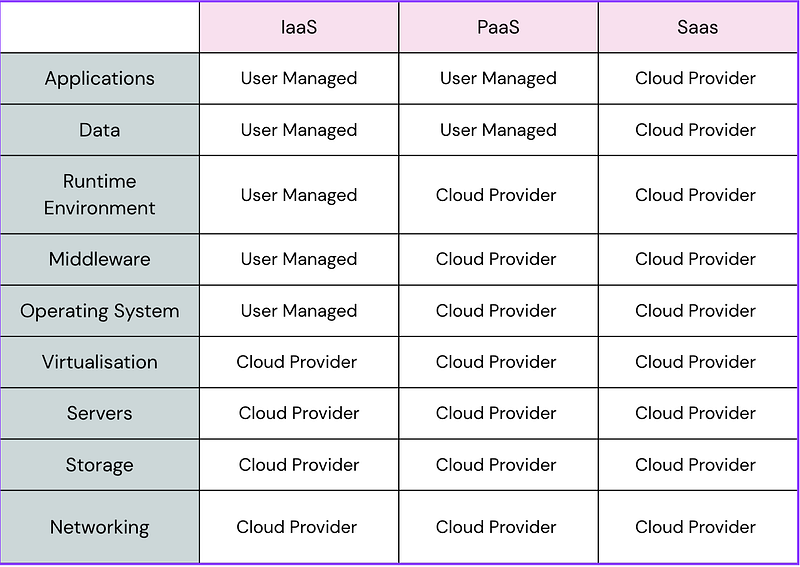
Responsibility Breakdown Chart
If you want to identify which service is IAAS, PAAS or SAAS you can see what users have to manage or what provider is managing and that way service can be differentiated as one of the above services.
Queries
Hope you have enjoyed reading it and learnt something new and valuable from this article today.
Now If you have any doubts or queries feel free to drop a comment or connect with me on my Topmate.
You can also reach out to me on my LinkedIn and follow me for updates on latest blogs.
Please do like this post if you enjoyed reading it.
Thanks for the read :)
Also, you can support me and my writings by treating me to a nice virtual cup of coffee ☕️